
The Unseen Campaign: Confronting Hate Speech in Cameroon’s Elections
By Mbehni Drusilla Nange_Intern_Civic Watch
As Cameroon approaches its 2025 general elections, the nation finds itself grappling not only with political uncertainty but with a more insidious threat to information in the form of hate speech. This phenomenon, often dismissed as mere rhetoric, has become a destabilizing force capable of inciting violence, eroding public trust, and undermining democratic participation. While political campaigns dominate headlines, a quieter, more principled campaign is unfolding behind the scenes which is a movement led by journalists, civil society actors, and advocates determined to confront hate speech and restore integrity to public discourse.
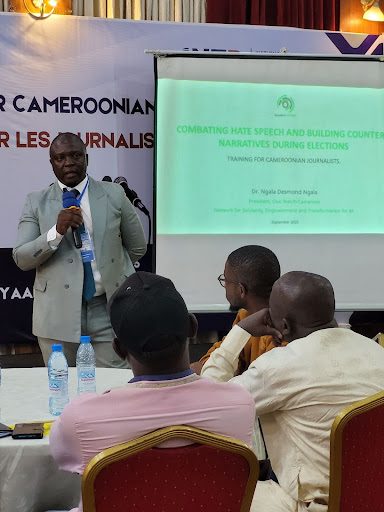
On September 12, 2025, the Network for Solidarity, Empowerment and Transformation for All (NewSETA), in partnership with the National Endowment for Democracy (NED), convened a strategic training session in Yaoundé under the theme “Combating Hate Speech and Building Confidence among Electors during Elections”. Among the key contributors was Dr. Ngala Desmond, President of Civic Watch Cameroon, whose presentation offered a sobering analysis of the media’s role in perpetuating or preventing hate speech, and a roadmap for ethical journalism in politically volatile times.
Cameroon’s electoral terrain is fraught with tension leading to Ethnic divisions, regional grievances, and political polarization, which have created fertile ground for hate speech to flourish. According to the United Nations Strategy and Plan of Action on Hate Speech (2019), hate speech is defined as “any kind of communication in speech, writing or behavior that attacks or uses pejorative or discriminatory language with reference to a person or a group on the basis of who they are.” In Cameroon, this often manifests in the form of ethnic slurs, regional stigmatization, and inflammatory political rhetoric especially during election cycles.
Dr. Desmond’s presentation emphasized that journalists are no longer passive observers. They are active participants in shaping public opinion and must navigate a minefield of misinformation, political manipulation, and public distrust. He further said the “stakes are high that unchecked hate speech can escalate into communal violence, suppress voter turnout, and delegitimize electoral outcomes”. The media’s role, therefore, is not just to inform but to safeguard peace and cohesion.
Understanding the Realities of Hate Speech
The training session delved into the anatomy of hate speech, unpacking its various forms and implications. Hate speech in the Cameroonian context includes ethnic profiling, incitement to violence, targeted disinformation, and the dehumanization of political opponents. These expressions are not abstract as they are embedded in campaign slogans, social media posts, and even mainstream news coverage.
The presentation referenced global frameworks, including Article 20 of the International Covenant on Civil and Political Rights (ICCPR), which prohibits “any advocacy of national, racial or religious hatred that constitutes incitement to discrimination, hostility or violence.” In Cameroon, where political discourse often intersects with identity politics, the danger is amplified. Hate speech does not merely offend, it divides, radicalizes, and destabilizes.
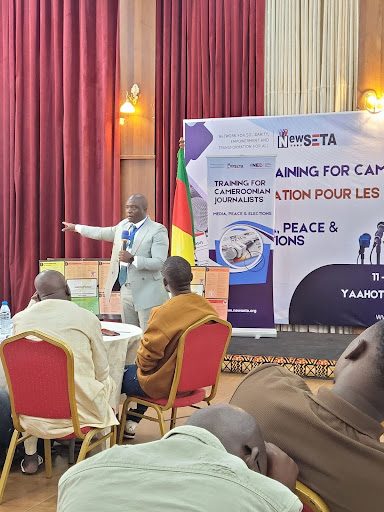
One of the most compelling insights from Dr. Desmond’s presentation was the dual role journalists play during elections. On one hand, “they can inadvertently amplify hate speech by quoting inflammatory remarks without context or critique”. On the other, “they can serve as moderators of public discourse challenging divisive narratives, promoting dialogue, and fostering understanding”.
Ethical responsibility becomes paramount as journalists must uphold impartiality, verify facts rigorously, and avoid sensationalism. They must also protect vulnerable sources and refuse to relay rhetoric that incites hatred or violence. As Desmond noted, “The journalist is not just a conveyor of information but a guardian of public conscience.” Their choices can either deepen societal fractures or build bridges across them.
Counter-Narratives: The Antidote to Hate
Central to the training was the concept of counter-narratives stories that challenge hate speech by promoting peace, inclusion, and diversity. These narratives are not reactive; they are proactive tools for reshaping public perception. Effective counter-narratives are grounded in truth, empathetic in tone, constructive in message, and engaging in format.
Examples include highlighting interfaith dialogue initiatives, showcasing community-led peacebuilding efforts, and amplifying voices from marginalized regions. In the Anglophone regions, for instance, journalists have begun documenting stories of resilience and reconciliation, offering a counterpoint to the dominant narratives of conflict and division. These efforts align with UNESCO’s Media and Information Literacy framework, which encourages critical engagement with media content and the promotion of inclusive narratives.
The presentation offered a robust toolkit for journalists committed to ethical reporting. Fact-checking emerged as a cornerstone journalists must verify claims before publication, especially in politically charged environments. Peace journalism, which emphasizes solutions and reconciliation over conflict and sensationalism, was also highlighted as a transformative approach.
Journalists were encouraged to amplify positive initiatives, such as youth-led civic engagement projects or cross-regional collaborations. Collaboration with civil society organizations, legal experts, and fact-checking platforms was recommended to strengthen accountability and support. These strategies are not just best practices, they are lifelines in a media ecosystem under siege.
Despite their commitment, journalists face formidable obstacles. Political and economic pressures often compromise editorial independence. Threats and intimidation both online and offline are common, especially for those reporting on sensitive issues. Limited resources for verification and the rapid spread of disinformation further complicate the landscape.
To counter these challenges, Dr. Desmond advocated for ongoing training in media ethics, legal support for journalists under threat, and the establishment of solidarity networks among media professionals. He also proposed the creation of reporting platforms for hate speech, enabling journalists and citizens to document and respond to harmful content. These solutions reflect a holistic approach, one that recognizes the systemic nature of the problem and the need for collective action.
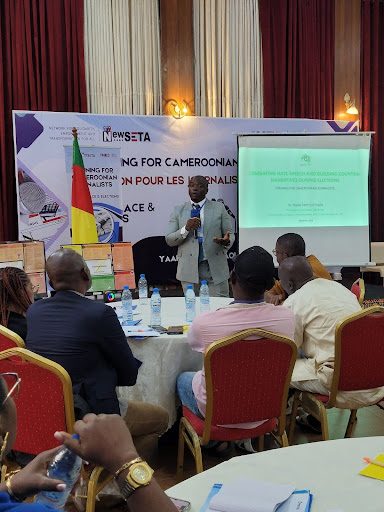
The presentation spotlighted successful initiatives that demonstrate the power of ethical journalism. The #FactsMatter237 campaign, launched during the 2020 elections, brought together journalists and fact-checkers to debunk false claims and promote verified information. The 2025 Multi-Stakeholder Coalition for Ethical Media, formed in anticipation of the upcoming elections, issued a joint declaration against disinformation and hate speech.
Balanced regional coverage also emerged as a key strategy. Journalists reporting from the Northwest and Southwest regions began highlighting peacebuilding efforts, community resilience, and inclusive governance models. These stories offered a counter-narrative to the dominant discourse of conflict and division, reinforcing the media’s role as a force for cohesion.
Civic Watch Cameroon: Building Impact from the Ground Up
At the heart of this movement is Civic Watch Cameroon, an organization that has consistently championed ethical journalism, civic education, and peacebuilding. Under Dr. Desmond’s leadership, Civic Watch has launched a series of initiatives aimed at transforming media culture and empowering journalists.
Their #HateFreeCameroon campaign mobilizes journalists, educators, and youth leaders to identify and challenge hate speech in their communities. Through workshops, digital toolkits, and public forums, the campaign fosters critical media literacy and promotes inclusive dialogue. Civic Watch has also established peace clubs in secondary schools, equipping students with the skills to mediate conflict and advocate for tolerance.
In collaboration with NewSETA and other partners, Civic Watch has trained over 200 journalists in peace journalism, fact-checking, and ethical reporting. Their impact is measurable not only in the stories being told but in the trust being rebuilt between media and the public. As Dr. Desmond emphasized, “We are not just training journalists; we are cultivating a culture of responsibility, empathy, and truth.”
According to the UNHRC, the fight against hate speech is not a peripheral concern, it is central to the health of Cameroon’s democracy. Journalists have the power to shape narratives, influence public opinion, and safeguard electoral integrity. But they cannot do it alone. Civil society, policymakers, and citizens must join the campaign to confront hate speech and promote ethical discourse.
Civic Watch Cameroon offers a blueprint for impact grounded in collaboration, education, and principled storytelling. Their work reminds us that the most powerful campaigns are not always the loudest. Sometimes, they are the ones that quietly restore dignity, rebuild trust, and reimagine what democracy can be.


Leave a Reply
Want to join the discussion?Feel free to contribute!