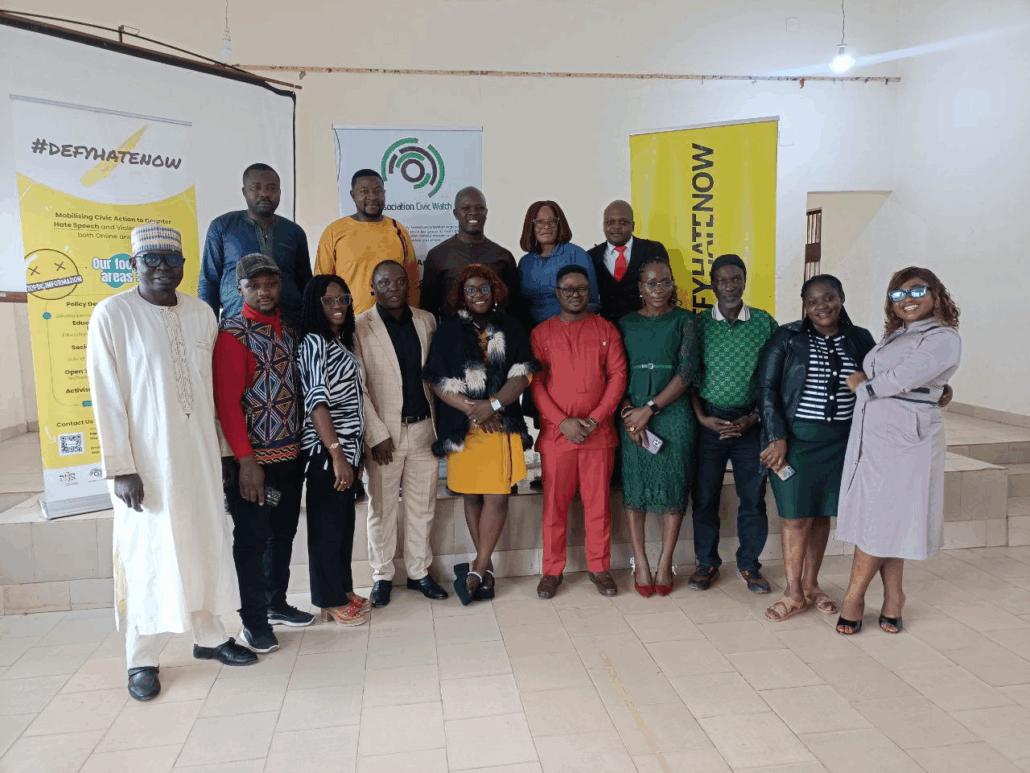
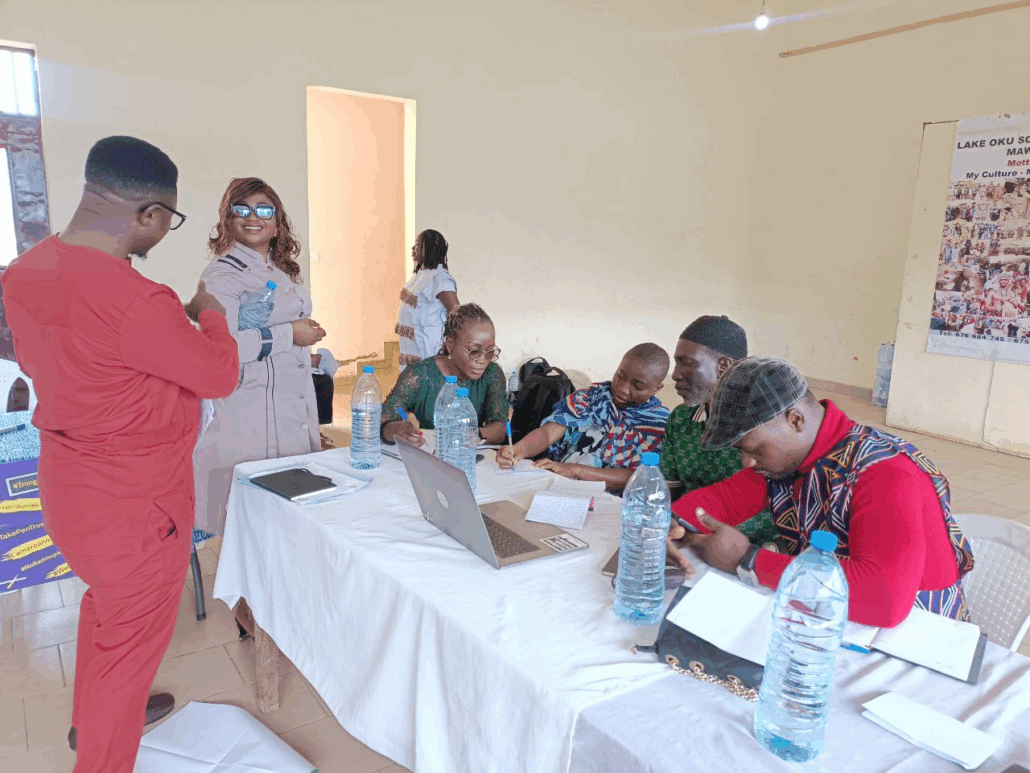
A multi-stakeholder dialogue forum was convened in Bamenda North West Region, on September 4, 2025, to promote a peaceful, inclusive, and hate-free elections ahead of the October 2025 polls. Held under the theme “Promoting Peaceful, Inclusive and Hate-Free Elections in the North West Region of Cameroon,” the forum brought together diverse voices committed to fostering democratic values and social cohesion in the region.
Organized by Civic Watch as members of the National Bilingualism Coalition, the one-day dialogue session brought together leaders of political parties, youth organizations, civil society actors, and media associations to deliberate on ways of encouraging peace, inclusion, and a hate-free electoral process. Discussions also focused on denouncing hate speech, xenophobia, and violence during and after campaigns, promoting ethical journalism, and strengthening community resilience against hate speech, misinformation, and divisive narratives.
The forum highlighted what stakeholders have been doing, what they can still do, and the ethical responsibilities they carry during the elections.
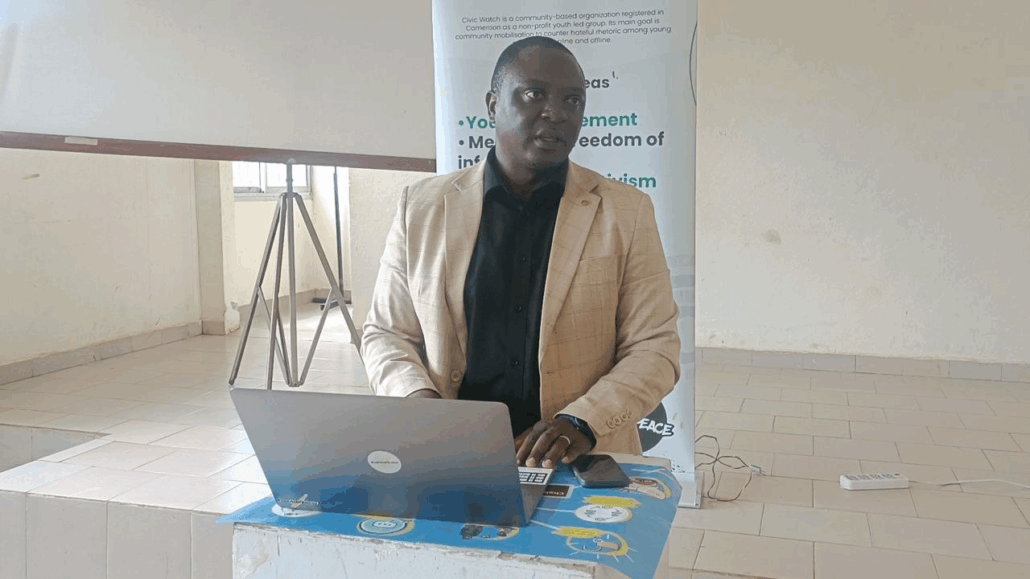
In his address, Civic Watch Lead Dr. Ngala Desmond Ngala stressed that political parties can conduct elections without violent exchanges and inflammatory rhetoric. He urged them to engage in inclusive civic education and build effective communication and language skills while considering their responsibility to citizens and the wider community.
Turning to the media, Dr. Ngala reminded journalism association representatives that as agenda setters, they should not only depend on what politicians say but must also play a role in managing conflicting situations during on-air programs and coverage. He warned that what is published can either increase or reduce hate speech and xenophobic exchanges among supporters. Despite challenges such as limited access to sources, conflicts of interest, sensationalism, and political affiliations, journalists were urged to verify information before dissemination.
Youth and civil society organizations were also called upon to go beyond encouraging voter registration and to inspire active participation, helping citizens distinguish between positive and harmful practices.
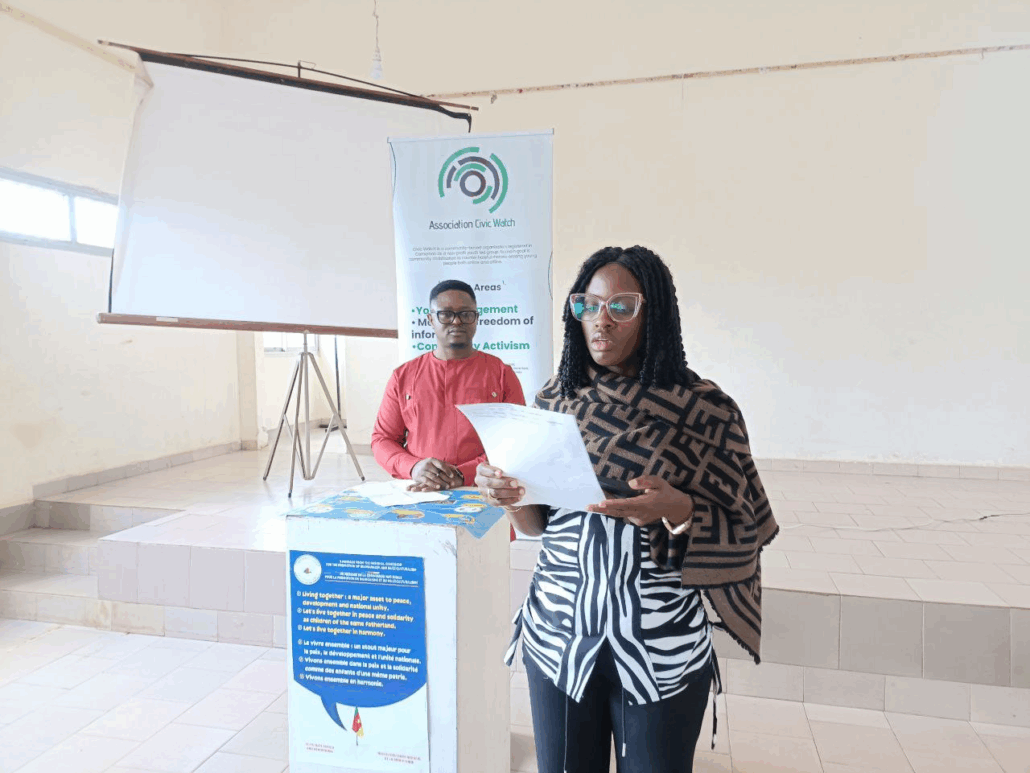
Facilitating the session, Dr. Sakah Bernard noted that hate speech undermines community resilience by inciting violence, weakening democracy, fostering political apathy, deepening divisions, and intimidating advocates of diversity.
Grassroots approaches suggested by participants included interpersonal dialogues, youth peace advocacy clubs in schools and communities, and amplifying social media fact-checking.
Group discussions on community collaboration with political parties and the media produced recommendations such as organizing public hearings between political leaders and communities, building partnerships between local/regional media and politicians to promote fact-checking, and raising awareness on the dangers of citizen journalism.
At the close of the session, each stakeholder group called on its counterparts to remain focused on goals and purpose, form strong coalitions,form strong coalitions and strengthen connectors than feed dividers, and improve communication skills to foster unity before and after campaigns.
https://civicwatch.cm/wp-content/uploads/2025/09/image-5.png9611280adminhttps://civicwatch.cm/wp-content/uploads/2021/11/Civic-Watch-e1652454008816-1030x249.pngadmin2025-09-12 07:35:112025-09-22 09:24:24At Multi-Stakeholder Dialogue Forum; Civic Watch Lead Calls for End to Bystanding on Issues of Hate Speech and Xenophobia.
As Artificial Intelligence steadily integrates into newsrooms and editorial workflows, a powerful and unsettling question rises to the forefront of civic discourse: Who now holds the authorship of truth? At a time when algorithms can produce entire articles in a matter of seconds and when falsehoods often travel faster than facts, journalism finds itself at a profound crossroads. The core principles of accuracy, context, and public trust are being tested in ways never seen before. It is within this complex and rapidly evolving environment that Civic Watch steps into the conversation not to resist innovation, but to challenge it with a renewed commitment to responsibility and humanity. We believe that technological advancement must be matched with ethical reflection, and that truth must remain rooted in transparency, civic values, and the lived realities of communities. As AI reshapes the media landscape, our work seeks to ensure that the voices of citizens, not just code, continue to shape the narrative.
Reflections from Civic Watch’s AI and Journalism Press Lunch
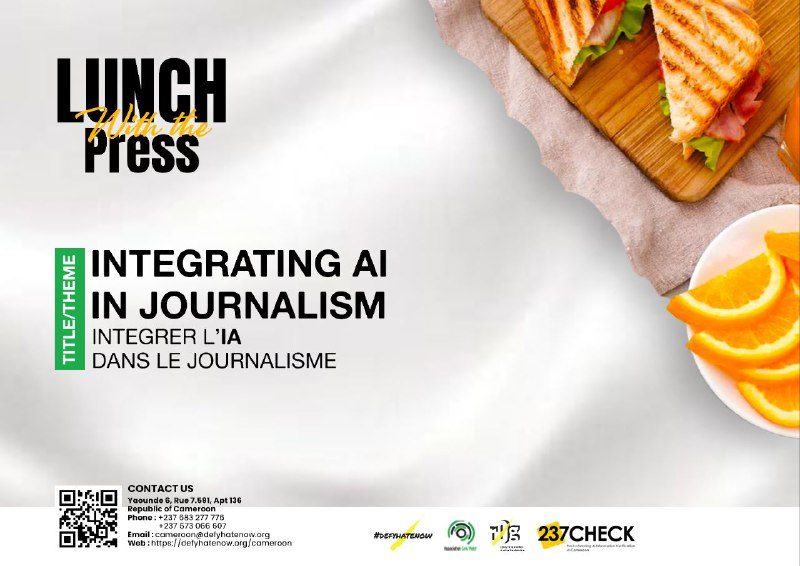
On July 25, 2025, Civic Watch hosted another press lunch that did more than gather people around a table, but sparked a civic dialogue at the intersection of technology and truth. Under the guidance of Dr. Ngala Desmond, peacebuilding consultant and Founder of Civic Watch, the event brought together journalists, researchers, developers, and concerned citizens to confront one of the most urgent questions of our media age: What happens to journalism when Artificial Intelligence joins the newsroom?
Framed under the theme “Integrating AI in Journalism”, the gathering explored far more than just the technical capabilities of machines. It challenged attendees to reimagine the future of news, not as a battleground between humans and algorithms, but as a potential site for collaboration. Could editorial integrity coexist with machine-generated content? How do we preserve human judgment, context, and ethical nuance in a space increasingly influenced by automation? The conversation was honest, provocative, and necessary. Participants debated whether machine precision could ever match the values that underpin journalism: accountability, empathy, and public trust. Rather than offering simple answers, the press lunch opened space for critical inquiry and collective visioning. In a time when innovation often races ahead of reflection, Civic Watch’s press lunch was a timely pause—and a powerful reminder that the future of journalism must be shaped not just by code, but by conscience.
Rethinking Journalism Beyond the Algorithm
In a warm, bilingual setting that echoed Cameroon’s rich cultural identity, Civic Watch transformed its headquarters into a space for reflection, curiosity, and dialogue. This was no conventional press event, no podiums, no rigid formats, no scripted performances. Instead, the atmosphere was relaxed, intentionally intimate, and deeply participatory. Attendees from all walks of life, seasoned journalists, tech developers, media students, civic leaders, and curious citizens, came together not as spectators, but as co-creators in a conversation about the future of journalism in the age of AI. The diversity in the room was not just demographic; it was ideological, experiential, and generational. This pluralism underscores Civic Watch’s vision of inclusive civic innovation: a media landscape where people are not just passive recipients of information but active architects in shaping how stories are told, shared, and trusted. By centering dialogue over debate, and people over platforms, the event invited participants to rethink journalism beyond the algorithm toward a future that is not just technologically advanced, but also deeply human.
AI’s Tools, Journalism’s Purpose, and Ethical Anchors in a Shifting Landscape
At the heart of the conversation was a grounding in the real: real tools, real concerns, and real opportunities. Through an insightful and hands-on presentation, Nigerian AI-for-media expert Chinedu Hardy Nwadike demystified how journalists can engage with AI tools like ChatGPT, Deepseek etc. He walked participants through step-by-step strategies to craft effective prompts, showing not just what the technology can do, but how to use it with intention. “AI is a tool, not a replacement. It demands discipline, discernment, and human creativity,” Chinedu emphasised. “Using AI doesn’t make you lazy, it depends entirely on how you use it.” His message was clear: AI can accelerate the process of journalism, but it should never replace the thinking behind it. “It’s not about abandoning journalism to AI,” he added, “it’s about letting AI add value to your journalistic effort.” This theme of responsible integration was echoed and deepened by Dr. Hervé Tiwa, Executive Director of Med.IA Lab, whose contributions added a layer of critical reflection. While acknowledging the potential of tools like ChatGPT, Manus, Hugging Face, and Gamma to revolutionise article drafting, content generation, and visual storytelling, Dr. Tiwa struck a cautionary note. “AI is a double-edged sword,” he said. “It can enhance journalism, but only in the hands of ethical professionals who refuse to surrender authorship.” He warned against the temptation to chase efficiency at the cost of editorial integrity, reminding the room that journalism is not just about output, but about responsibility. “Journalists must never abandon their core mission to machines,” he declared. “The future of journalism doesn’t lie in outsourcing truth. It lies in reclaiming the tools and guiding their use with purpose.”
Perhaps the most memorable takeaway was his closing remark
“The future of journalism will not be written by AI, but by the journalists who master it.”
This sentiment captured the spirit of the day: cautious optimism, guided by ethics, and rooted in a shared belief that technology must serve humanity, not the other way around.
A Civic Manifesto for Human-Centered Media
What unfolded at Civic Watch’s press lunch was far more than a dialogue on digital tools; it emerged as a powerful civic manifesto for the future of journalism. Far from a starry-eyed embrace of emerging technology, the gathering offered a grounded, critical, and deeply values-driven perspective on what it means to inform, engage, and protect society in the AI era. “Journalism isn’t just about producing content,” declared Dr. Ngala Desmond, Founder of Civic Watch. “It’s about provoking thought, demanding accountability, and protecting democracy.” His words set the tone for an event that called on participants not just to adapt to change, but to shape it with intention and conscience. The message was unmistakable: journalism must evolve, but it must never dissolve. Civic Watch champions a vision of augmented journalism, where technology acts as an extension of human insight, not a replacement for it. In this model, AI becomes a tool for amplifying the journalist’s voice, not dulling it; for improving workflows, not erasing editorial responsibility. Dr. Ngala concluded with a timely and urgent reminder: “With presidential elections around the corner, misinformation is certainly on the rise. But with the AI tools discussed here today, I’m confident we’ll see more verification, more fact-checking, and more vigilance.”
In a time of technological disruption and democratic fragility, Civic Watch’s message rings clear: the future of media must remain human at its core, guided by truth, driven by ethics, and powered by people.
https://civicwatch.cm/wp-content/uploads/2025/08/5792091272620656253-2.jpg566800adminhttps://civicwatch.cm/wp-content/uploads/2021/11/Civic-Watch-e1652454008816-1030x249.pngadmin2025-07-30 07:48:582025-08-01 08:44:37Taming the Algorithm: Reclaiming Editorial Integrity in the Age of AI: Who Still Holds the Pen When Machines Can Write the Story?
À la veille de l’élection présidentielle et face à la montée des divisions, nous affirmons notre unité pour condamner fermement les discours de haine et réaffirmons notre engagement en faveur de la paix, de la tolérance et de l’unité nationale au Cameroun
https://civicwatch.cm/wp-content/uploads/2025/06/coalition-declaration.png915649adminhttps://civicwatch.cm/wp-content/uploads/2021/11/Civic-Watch-e1652454008816-1030x249.pngadmin2025-06-19 09:40:562025-06-23 09:44:33Déclaration de la « Coalition multi-acteurs pour la lutte contre la désinformation et les discours haineux lors des élections au Cameroun »,Juin 2025
In the face of rising divisive rhetoric on the eve of the Presidential elections, we stand united to condemn hate speech and reaffirm our commitment to peace, tolerance, and national unity in Cameroon.
https://civicwatch.cm/wp-content/uploads/2025/06/coalition-declaration.png915649adminhttps://civicwatch.cm/wp-content/uploads/2021/11/Civic-Watch-e1652454008816-1030x249.pngadmin2025-06-19 08:14:172025-06-23 09:40:41Declaration of the “Multi-stakeholder coalition for the fight against misinformation and hate speech during elections in Cameroon,” June2025
Changing Narratives on Information Integrity in Cameroon. A Journey of Fact-Checking, Media Literacy, and Digital Empowerment
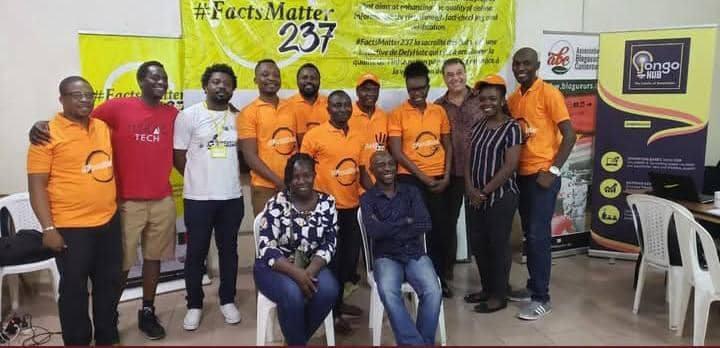
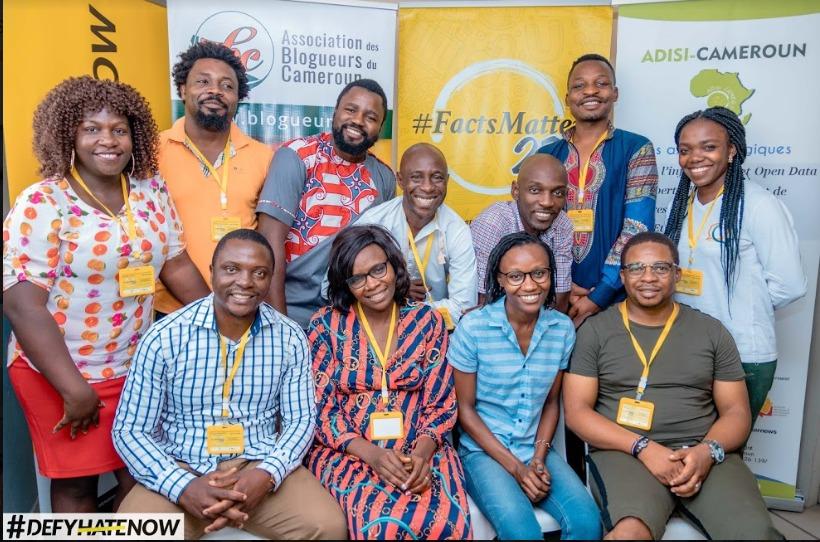
#FactsMatter237 Fellows
It all started in 2020 with #FactsMatter237 with a vision of educating bloggers, content creators, and community leaders on information verification, fact-checking, data journalism, and digital rights educating media professionals, both online and offline in Cameroon. #FactsMatter237 was aimed at monitoring and mapping viral trends on social media related to the key thematic issues in Cameroon. After the outburst of the Anglophone crisis in 2016 and the 2018 presidential elections, the social media space in Cameroon was full of hate speech, misinformation, incitement to violence, and violent extremism. #FactsMatter237 came in to join other existing platforms like Data Cameroon, STOPBLABLACAM, Stopintox.cm to create awareness on #MIL. With 7 fellows Pedmia Shatu, Tarhyang Tabe, Frank William Batchou, Fotso Fonkam, Marc Ghislain, Armelle Sitchoma, and Romuald Landry Nguemkap, the train was on the move. Following the success of the #FactsMatter fellowship and the feedback from partners and fellows, the program was renamed Africa Fact-checking fellowship. It later moved to #AFFCameroon with fellows from cohorts one to ten. Dedicated fellows who found the training interesting, adventurous, and full of discoveries. Fellows worked hard to write Social Media Health Reports, which are all about information online that could affect the country and that made a lot of noise in the social media space. Additionally, they fact-checked articles that are published on the 237Check website. Fellows had specialised meetups in their various communities. They organised meetings with youths, students, pupils, women, community leaders, etc., to share the dangers of spreading false information, propagating hate speech, and the wrong use of social media. The meetups helped fellows understand and master the work better.
#FactsMatter237 fellows become cohort 1 fellows of #AFFCameroon.
The #AfricaFactCheckingFellowship (AFFCameroon) is an initiative by #defyhatenow started in partnership with Data Cameroon and Paul Joel Kamtchang being the main trainer at that time was aimed at promoting fact-checking, data journalism, and digital rights among journalists, bloggers, and content creators in Africa. Fellows of each cohort had a three-month program that was geared towards providing fellows with skill sets and tools needed to tackle misinformation challenges in their countries and communities. AFFCameroon programs consist of three main stages, each running through one month and ending with a particular assignment. From discovery to practical sessions, and going to the field. They fellows had an assignment to share knowledge learned with their communities and bring feedback and difficulties encountered.
Fellows have been trained from all regions in Cameroon, and as such, #AFFCameroon fellows can be spotted in each region in the national territory, including Chad.
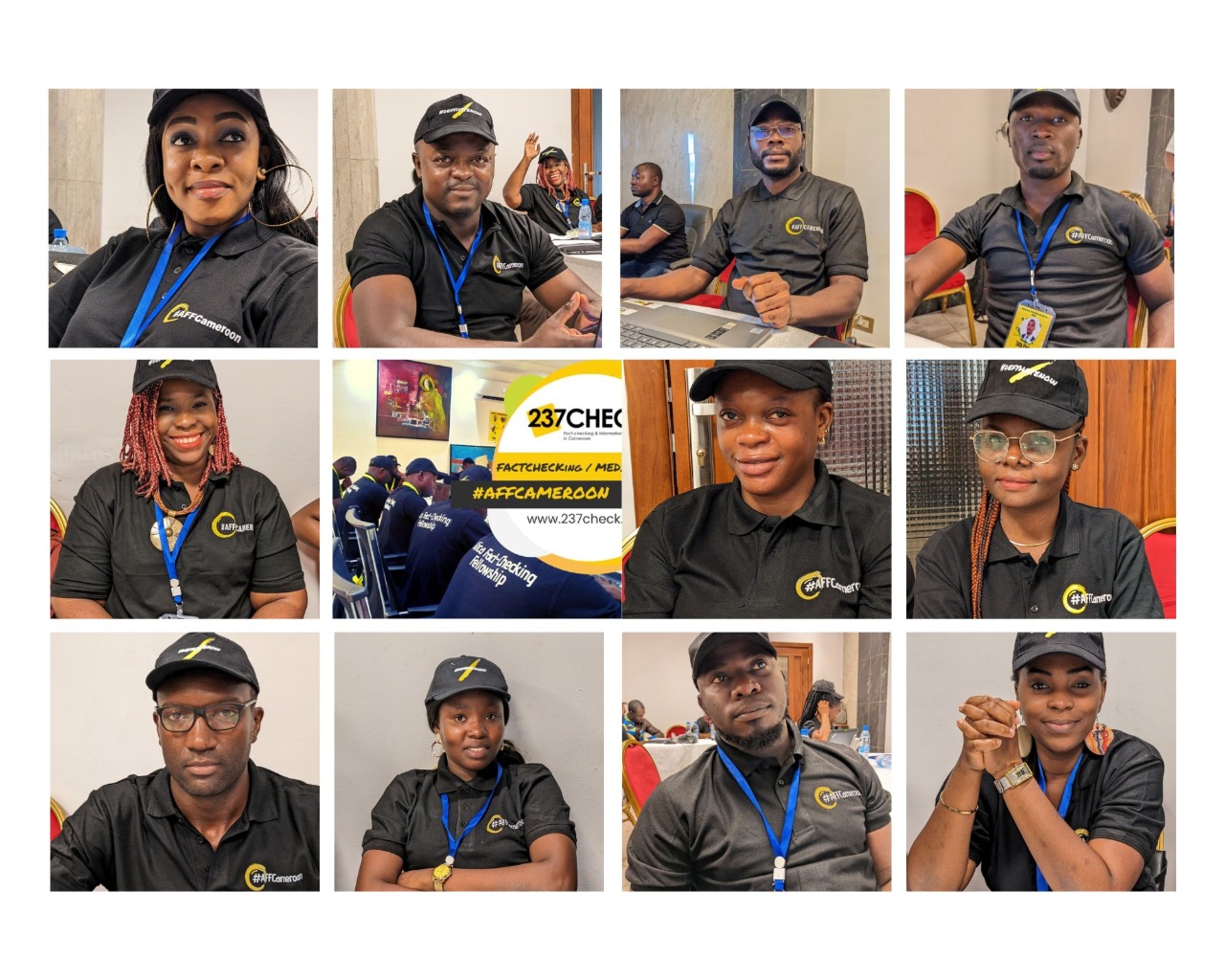
#AFFCameroon Fellows in Session
Under the coordination of Donald Tchiengueand supervision of Dr. Ngala Desmond Ngala, AFFCameroon moved to the grand North which was termed “ Special Grand Nord”. ‘Special,’ because of its distance and many youths from that region were not very much versed with how to use the internet, how to email and use social media. It brought about journalists from Maroua, Garoua and Ngoundere and it was a beautiful experience for fellows who asked for more of such training. The training in the grand North gave light to “ Septentrion Check” founded by some of the fellows trained by #237Check in Garoua.
Digital Coordinator Donald Tchiengue with AFFCameroon cohort 10 fellows in session.
Aside from training and fact checking, the AFFCameroon program shed more on how they could behave online, communicate and post. After the training, fellows produced documentaries and television and radio programs like; Junior Haussin Noulapoum Kuaye’s programm, who presents a fact checked articles on Wednesdays entitled “OUI ou NON” on the Canal 2 International television channel., a documentary by Jabi Katy Chaletitled: Breaking The Silence: A Survivor’s Journey Against Hate. By 2024, 250 fellows had been trained with each having a positive impact on their professional as well as private life and it has reached 20,000 people through its community engagement. Other fellows, such as Mbuh Stella and Badal Fohmoh have created fact checking pages “ Factbox” and “ Class Pro,” respectively on facebook and X ( formerly Twitter), where they share fact checking tips. Some Cohort 9 fellows, passionate about the training and knowledge they gained during their time at #AFFCameroon, created an initiative after their training known as “Facthunters.”
This initiative is aimed at sensitizing online users about hate speech, misinformation, disinformation, and the importance of fact-checking.
Read full article on #AFFCameroon’s success story here.
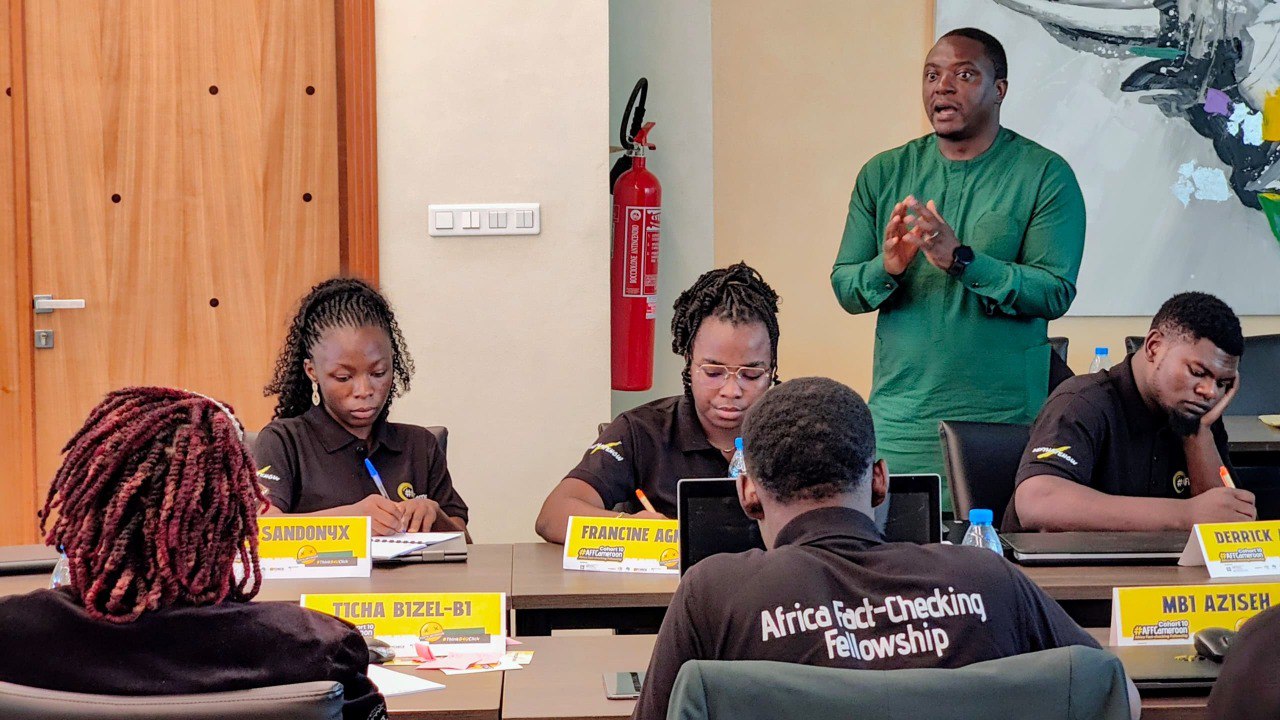
Dr. Ngala Desmond Ngala #defyhatenow Cameroon Country Project Manager in session with Fellows
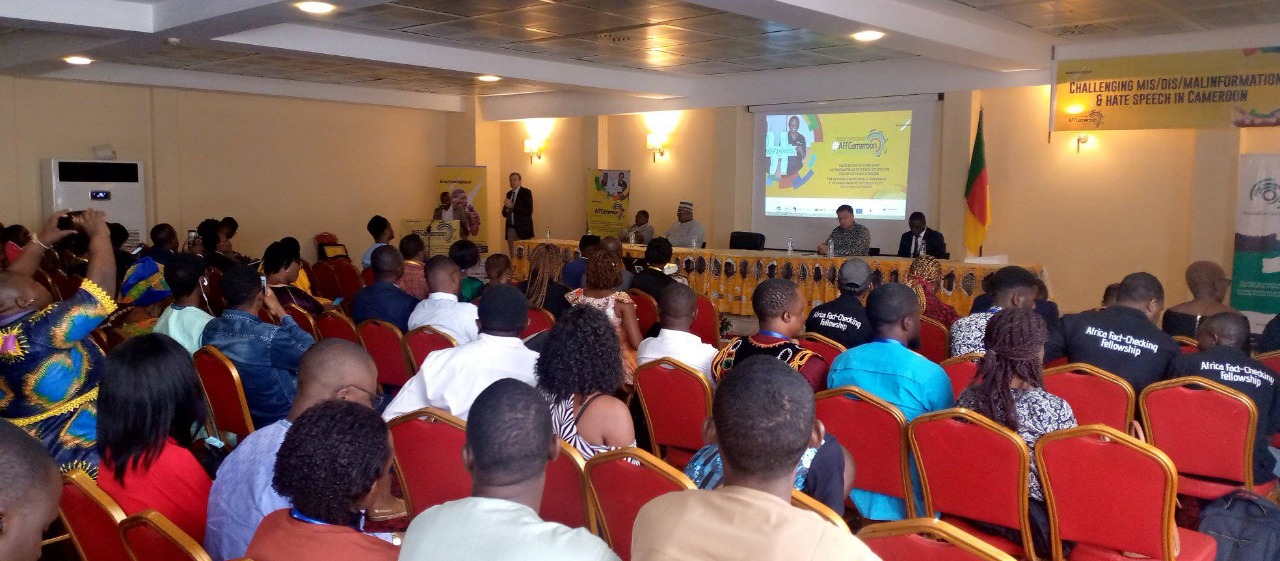
Two major #AFFCameroon conferences were organised in 2022 under the theme “Toward a Synergy of Actions Against Mis/Disinformation and the Spread of Hate Speech for Peace and Development in Cameroon,” followed by the 2024 edition held under the theme, “Combating Digital Threats to Elections in Cameroon: Strategies to Fight Disinformation During the Electoral Period.”
These impactful gatherings brought together public and private institutions, diplomatic missions, international and regional organizations, civil society organisations, educational institutions, media professionals, and AFFCameroon Fellows. The aim was to create a synergy of actions and find effective solutions to reduce the negative effects of misinformation and disinformation on lasting peace and social cohesion in Cameroon and Africa at large.
Through plenary sessions, workshops, insightful masterclasses, and rich networking opportunities, the conferences made participants determined and afresh to tackle disinformation. Fellows left with renewed zeal to amplify their work online, fact-check information thoroughly, and actively debunk fake news. For many, the events offered a deeper understanding of what fact-checking truly involves, how misinformation and disinformation are spread, and practical ways to identify and reduce them.
Importantly, the conferences paved the way for new partnerships with fact-checking organizations, government bodies, civil society organisations, individuals, and private institutions. We remain open to even more collaborations and sponsorships, particularly to extend our reach into underdeveloped areas of Cameroon. These are places where misinformation, hate speech, and violent extremism are the order of the day, but awareness and sensitization remain low.
Our vision is to reach these communities, especially those with limited access to information or the internet, and empower them with the tools to access, assess, and share accurate information both in their communities and online.
#AFFCameroon Conference.
AFFCameroon wins the 2025 #MIL Impact Award prize in Marseille, France, it is a milestone achievement that deserves celebration by doubling efforts and engaging more communities across Africa to promote safe online spaces, digital rights, and a #HateFreeAfrica.
This award comes at a time when Cameroon’s social media space is overwhelmed with hateful content stemming from intertribal conflicts and political rivalries, as the country faces election fever. This is a crucial period that calls for increased action from the #defyhatenow AFFCameroon program and its fellows to ensure the elections proceed smoothly and peacefully.
It requires intensified sensitization on the responsible use of social media, the importance of thinking before clicking (#ThinkB4UClick), staying respectful, valuing others’ opinions, and correcting misinformation or harmful content online in a respectful manner.
#AFFCameroon announced winner of the South Shore #MIL Award in Marseille, France.
#MIL Impact Award won by #AFFCameroon fellowship
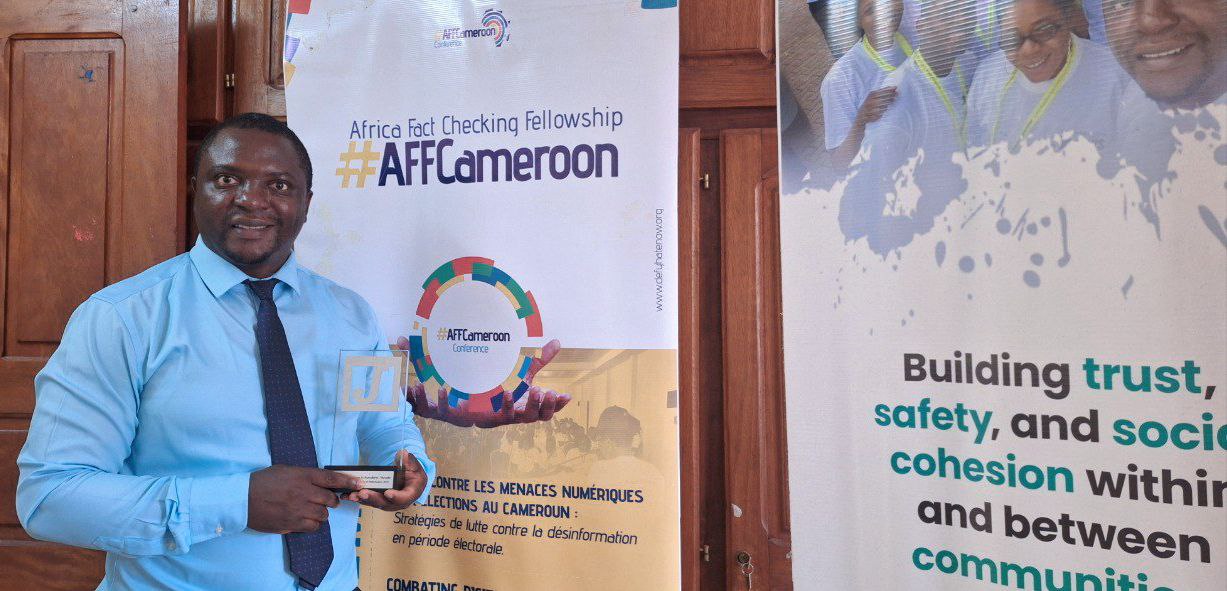
#defyhatenow Country Project Manager Dr. Ngala Desmond Ngala with the Rives Sud MIL Prize
AFF Cameroon has been a game-changer for me. I’ve learned to think before I click and consider the impact of my words. This newfound mindfulness helps me navigate conversations with care, ensuring I contribute positively. Beyond personal growth, AFF Cameroon has provided invaluable networking opportunities, introducing me to professionals who are shaping my career path. I’m grateful for the experience and thrilled to be part of the fact-checking community. Thank you, AFF Cameroon, for this enriching journey.
Francine AGNAMA
Hello Everyone,
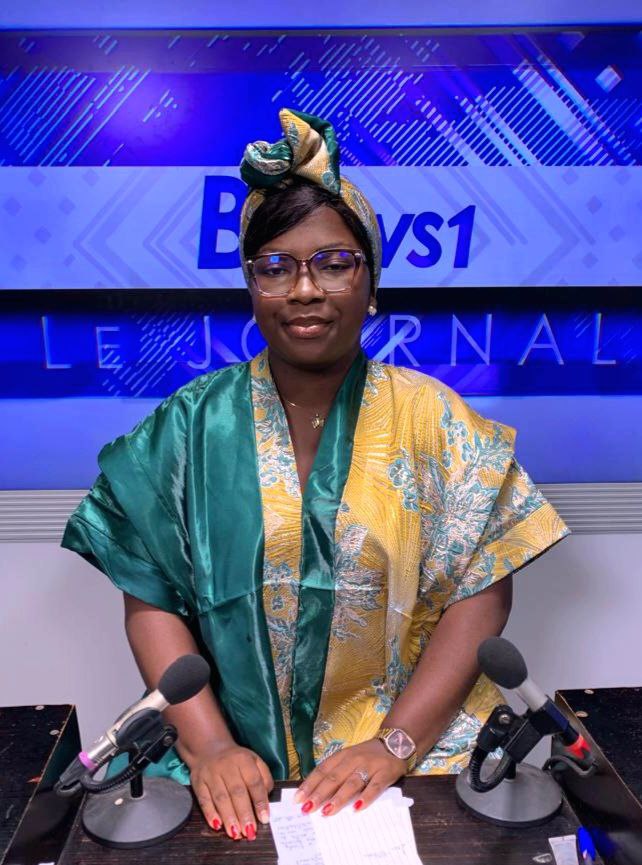
Je suis Francine AGNAMA journaliste, diplômée de L’ESSTIC option Édition et Arts Graphiques, Boursière de la 10eme Cohorte #AFFCameroon. Présentatrice du journal du week-end sur Bnews1 le Tam-Tam du continent. Ma formation à AFFCameroon a été l’ouverture d’une porte des étoiles dans ma vie sur le plan professionnel. Avant j’étais journaliste Oui mais Sans valeur ajoutée, Aujourd’hui je peux reconnaître en un laps de temps si une information est vraie ou fausse. Aujourd’hui je suis une pièce maîtresse dans mon lieu de service. Je suis celle qu’on sollicite quand il faut vérifier la véracité d’une information contribuant ainsi à la lutte contre la désinformation sans cesse croissante. Aujourd’hui je suis Factcheuse grâce à AFFCAMEROON.
Merci , Merci, Merci
Parfait Taiwe ( Bourscier de la cohort 6 d’#AFFCameroon)
Lorsque j’ai commencé à m’engager dans la lutte contre la désinformation, je ne possédais aucune connaissance en fact-checking. C’est lors de ma sélection par #AFFCameroon, dans le cadre du programme #defyhatenow, que j’ai découvert les principes fondamentaux du fact-checking, appris à structurer un article de vérification et à maîtriser plusieurs techniques de vérification des faits.
Grâce à cette formation, j’ai poursuivi dans cette voie avec le soutien d’AFFCameroon, en menant des actions sur le terrain et en contribuant à la rédaction d’articles de vérification des faits. Ce parcours m’a conduit à intégrer Code for Africa en tant que formateur.
Aujourd’hui, mon rôle au sein de Code for Africa consiste à animer des sessions de formation et à accompagner les rédactions, les individus ainsi que les organisations de la société civile (OSC) sur les questions liées au fact-checking.
Pechuqui Laurata (#AFFCameroon cohort 7 fellow.)
The African Fact-Checking Fellowship (AFF) Cameroon transformed my approach to journalism, equipping me with the skills to detect and counter misinformation, disinformation, and hate speech. It empowered me to share these tools with others through workshops and storytelling.
As a result, my report on youth and hate speech won Best Story on Peace and Peaceful Coexistence at the 2023 ABC Awards. I also produced a documentary on hate speech’s impact on young people, was awarded Best Documentary at the 2024 Camraise Academy Awards, and received the Video4Peace Award from Defyhatenow. In the same year, I was named Peace Journalist of the Year at the Victoria International Media Merit Awards.
AFF Cameroon has positioned me as a national voice for truth, peace, and responsible journalism.
https://civicwatch.cm/wp-content/uploads/2025/06/photo_2025-06-16_14-00-12.jpg7201280adminhttps://civicwatch.cm/wp-content/uploads/2021/11/Civic-Watch-e1652454008816-1030x249.pngadmin2025-06-12 10:55:262025-06-17 11:02:22From #FactsMatter237 to #AFFCameroon and Winning the #MIL South Shore Award
https://civicwatch.cm/wp-content/uploads/2025/05/Gp3y0JAWMAEi21s.jpg12801023adminhttps://civicwatch.cm/wp-content/uploads/2021/11/Civic-Watch-e1652454008816-1030x249.pngadmin2025-05-06 10:55:542025-05-07 10:59:41COMMUNIQUÉ DE PRESSE: AFFCameroon Remporte Un Prestigieux Prix d’Excellence pour la Promotion de l’éducation aux Médias et La Vérification des Faits en Afrique
https://civicwatch.cm/wp-content/uploads/2025/05/Gp3y0JAWMAEi21s.jpg12801023adminhttps://civicwatch.cm/wp-content/uploads/2021/11/Civic-Watch-e1652454008816-1030x249.pngadmin2025-05-06 08:54:122025-05-07 10:57:49PRESS RELEASE: #AFFCameroon Wins Prestigious Excellence Award for Advancing Media Literacy and Fact-Checking in Africa
FROM SILENCE TO ACTION: PARADIGM INITIATIVE, CIVIC WATCH PARTNER TO CHAMPION DIGITAL RIGHTS IN CAMEROON.
Group Picture with Participants.
When 30 -year-old Manka’a (Not her real name) from Bamenda began receiving anonymous threats on Facebook after reporting on the Anglophone crisis, she thought it was a one-off, but the harassment grew relentless, derogatory messages, and death threats flooded her inbox. Feeling unsafe, she deactivated her social media accounts, effectively cutting herself off from the digital world.
“I felt silenced and alone,” Manka’a recalls. “I didn’t even know if there were laws to protect people like me online so I had to run out of Bamenda for my safety.”
Manka’a’s experience mirrors that of many Cameroonians whose rights are violated in digital spaces, often with little knowledge of how to seek redress.
This narrative is beginning to shift, thanks to initiatives like the Digital Rights Academy co-organized on April 14, 2025 by Paradigm Initiative and Civic Watch.
The one day academy brought together journalists, civil society actors, and communication experts in Yaounde for a deep dive into digital rights, data protection, and advocacy strategies. It came at a pivotal moment, as Cameroon heads toward a high-stakes presidential election later this year an event historically marred by censorship, internet blackouts, and harassment of online voices.
Dr. Desmond Ngala, President/Founder Civic Watch
“I think data rights in Cameroon today are no longer a taboo topic,” said Ngala Desmond, Founder of Civic Watch. “Unlike before, we’re seeing a surge in awareness, but also an increase in violations, especially as we approach the elections. This partnership between Civic Watch and Paradigm Initiative could not have come at a better time.”
Paradigm Initiative’s Director, ‘Gbenga Sesan, emphasized that digital rights are fundamental human rights. “If the digital environment does not support the rights of citizens, we will never achieve a thriving digital economy,” he said. “Every internet shutdown, every act of surveillance, costs a country, not just politically, but economically.”
‘Gbenga Sesan, Executive Director Paradigm Initiative
Through interactive sessions and real-life case studies, the academy introduced participants to key resources such as LONDA, a research report assessing digital rights across twenty six African countries and REPOTI, an online platform where citizens can report digital rights violations and seek redress.
For Ngala Hansel, a journalist and participant, the experience was eye-opening.
“The digital rights bill passed just four months ago, and until now, it was all blurry to me,” he admitted. “I now understand how to protect people’s information, and more importantly, how to protect myself.”
As elections loom, Hansel expressed concerns shared by many Cameroonian journalists.
Ngala Hansel, Journalist/Participant
“We’re expected to critique power, but here, that’s often treated like treason. Now I know where the legal lines are and when to take the risk to speak the truth.”
The forum also spotlighted a deeper cultural issue; the normalization of silence.
“Citizens have become so used to rights violations that they call it ‘resilience’,” ‘Gbenga observed. “But that’s just acceptance. True advocacy demands we push back, document, and demand better.”
With platforms like the Digital Rights and Inclusion Forum (DRIF) set to hold its next edition in Zambia later this month, Paradigm Initiative continues to create safe spaces for these crucial conversations.
As the final session wrapped up, participants were urged to take what they had learned beyond the academy.
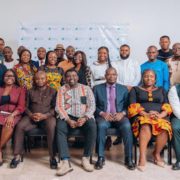
cross section of participants in session
Ngala Desmond echoed a call to action. He said “Nobody is going to make this job easy for you. Speak up when rights are violated”. Let’s be clear, governments aren’t the only violators. Users, platforms, and regulators all have a role.”
“You’re communication experts,” ‘Gbenga said. “Mix that with your new knowledge and tell the world what a digital Africa should look like, one where rights are respected, and no one is forced offline” just like it was for Manka’a.
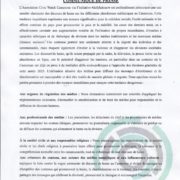
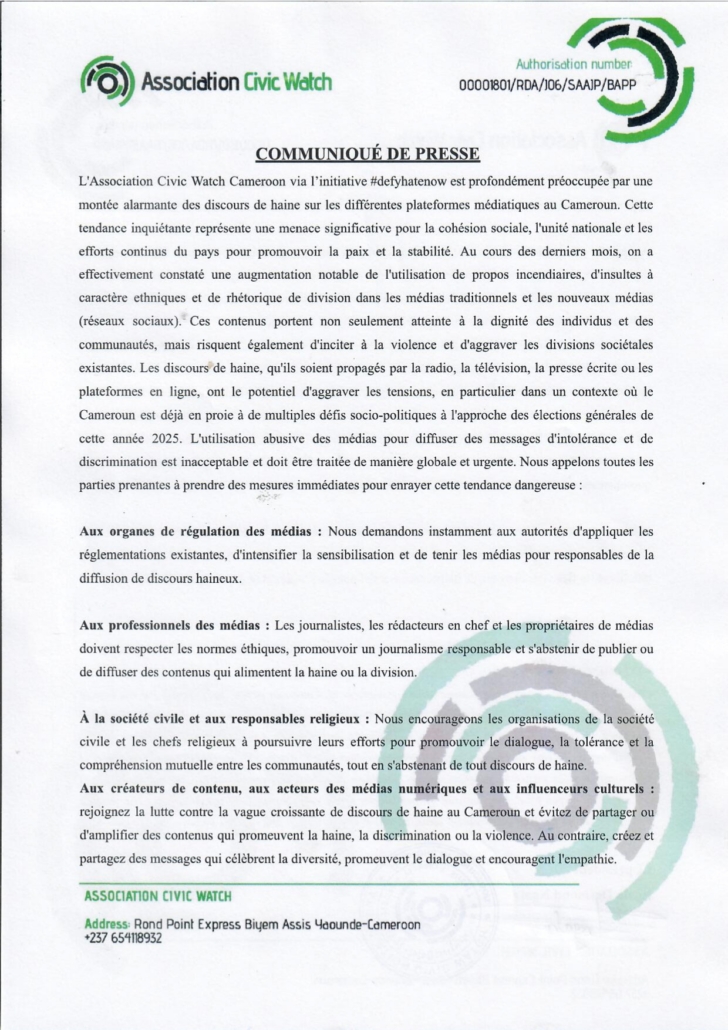
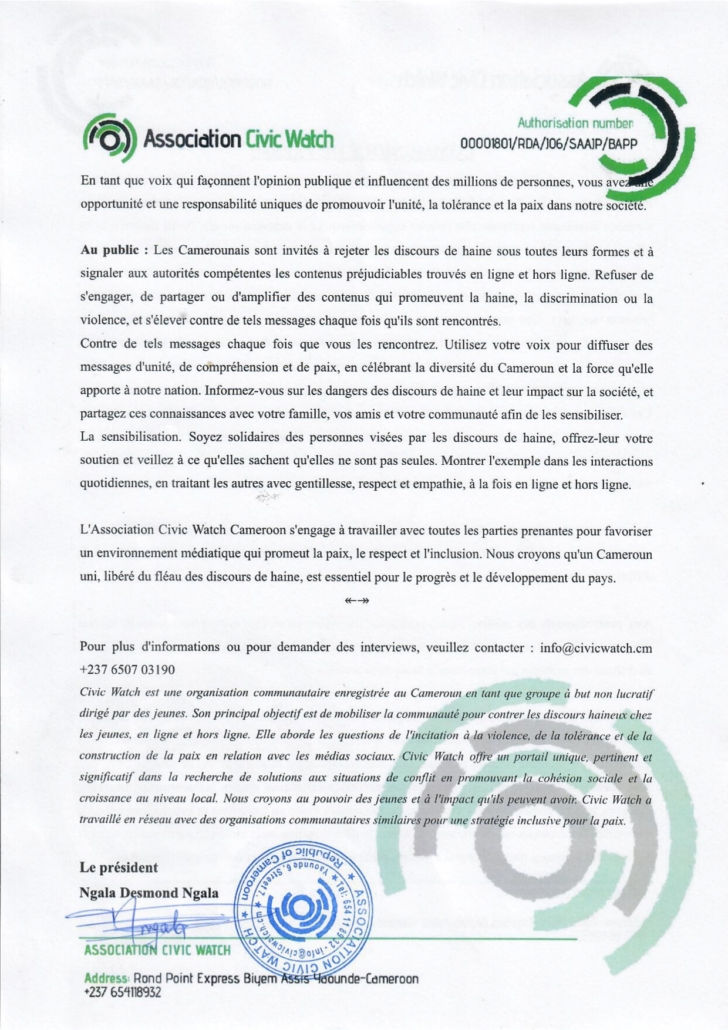
https://civicwatch.cm/wp-content/uploads/2025/03/Communique-de-presse-CIVIC-WATCH1_page-0001.jpg17551240adminhttps://civicwatch.cm/wp-content/uploads/2021/11/Civic-Watch-e1652454008816-1030x249.pngadmin2025-03-12 23:14:002025-03-17 11:26:42Communiqué de presse sur l’augmentation alarmante des discours de haine sur les différentes plateformes de médias sociaux au Cameroun







 cross section of participants in session